
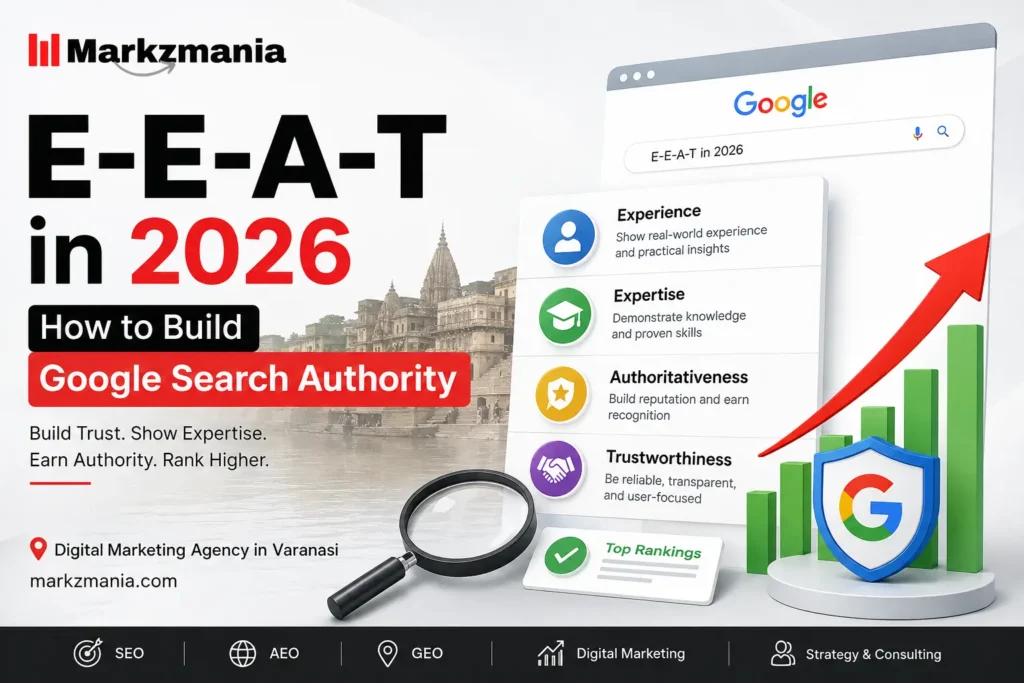
E-E-A-T in 2026 How to Build Google Search Authority
In 2026, ranking on Google (and appearing in AI Overviews or AI Mode) depends less on keyword tricks and more on whether Google’s systems and quality raters see your site as genuinely helpful, experienced, and trustworthy.
E-E-A-T stands for Experience, Expertise, Authoritativeness, and Trustworthiness. It is not a direct ranking score or algorithm multiplier. It is the quality framework from Google’s Search Quality Rater Guidelines that trains and evaluates the systems ranking content. Google has stated that of these aspects, trust is most important.
o build Google Search Authority and strong E-E-A-T in SEO in 2026, create people-first content that shows real first-hand experience, demonstrate clear expertise through named authors and accurate depth, earn external recognition (links, mentions, citations), prove trustworthiness with transparency and consistency, and build topical authority through comprehensive, interlinked topic clusters. These signals help traditional rankings and visibility in generative AI features because AI Overviews and AI Mode pull from the same core quality systems.
This guide is written for business owners, SEO professionals, digital marketers, content creators, website owners, startups, and agencies in India who want local and national visibility. It focuses on practical, long-term methods rather than short-term hacks.
Markzmania specialises in practical SEO, AEO, and GEO strategies that prioritise long-term search visibility, topical authority, trust, and qualified organic traffic.
What E-E-A-T Really Means in 2026
Google’s systems use many signals to identify content that aligns with strong Experience Expertise Authoritativeness Trustworthiness. The framework is especially weighted for YMYL (Your Money or Your Life) topics — health, finance, safety, legal, and similar areas that can impact people’s lives.
Experience
The second “E” was added in December 2022. It asks: Does the creator have first-hand, lived experience with the topic? A product review from someone who actually used the product, or a service guide from someone who has delivered the service repeatedly, carries more weight than pure theory or rewritten summaries. 2026 core updates have further amplified experience signals — original details, screenshots, process notes, and specific outcomes help.
Expertise
Does the creator (or the organisation) demonstrate deep, accurate knowledge? This can come from formal qualifications, years of practice, or clear evidence of understanding nuance. Named authors with verifiable backgrounds, accurate technical detail, and proper sourcing all contribute.
Authoritativeness
Is the site or creator recognised by others in the field? This is largely an off-site signal — quality backlinks, brand mentions, citations, industry recognition, and consistent entity presence across the web. Authority cannot be claimed; it is earned through recognition.
Trustworthiness
The most important pillar. Can users (and Google) trust the information, the site, and the people behind it? Clear contact details, transparent about pages, accurate claims, secure site, consistent entity information, and absence of misleading or low-value practices all support trust.
E-E-A-T SEO in 2026 is inseparable from topical authority, semantic SEO, helpful content standards, and entity consistency. Sites that only chase individual keywords without depth or credibility struggle more than ever.
Why Google Search Authority Matters More in 2026
Google’s generative features (AI Overviews and AI Mode) are grounded in the same core ranking and quality systems as traditional search. Pages that are indexed, eligible for snippets, and demonstrate helpful, reliable, people-first content have a stronger chance of being retrieved and cited.
Core updates in 2025–2026 continued to reward original information gain, experience signals, and site-level coherence while demoting thin, unoriginal, or purely AI-generated material that lacks differentiating value. Topical focus (how tightly a site clusters around specific subjects) and entity clarity have become more important for both classic rankings and AI visibility.
For Indian businesses targeting local and national search, strong SEO trust signals and clear local entity signals (consistent NAP, Google Business Profile alignment, local citations, regional language support where relevant) help establish credibility faster in competitive markets.
How to Build Genuine Google Search Authority: Practical Pillars
1. Demonstrate Real Experience
- Include first-hand details, processes, results, or observations that only someone who has done the work would know.
- Use original photos, screenshots, or data from actual work (properly anonymised if needed).
- Avoid generic advice that could have been written by anyone.
2. Show Expertise Clearly
- Publish under named authors with real bios, credentials, and links to professional profiles.
- Cover topics with enough depth and accuracy that an expert would recognise the quality.
- Cite reliable primary sources and keep claims verifiable.
3. Build Authoritativeness Off-Site
- Earn links and mentions from relevant, reputable sites in your niche.
- Maintain consistent brand and entity information across the web (website, social, directories, knowledge panels where applicable).
- Focus on digital PR, expert contributions, and genuine relationships rather than pure link volume.
4. Prioritise Trustworthiness
- Make ownership, contact information, and policies easy to find.
- Keep content accurate and update it when facts change.
- Avoid exaggerated claims, hidden affiliations, or manipulative tactics.
- Ensure technical trust signals (HTTPS, mobile usability, clear privacy practices).
5. Develop Topical Authority
Topical authority and E-E-A-T reinforce each other. Deep, coherent coverage of a subject area signals expertise and helps Google (and AI systems) understand your site as a reliable source on that topic.
Use content clusters: one comprehensive pillar page + supporting pages that cover related subtopics and questions, all interlinked naturally. Aim for information gain — something new, clearer, or more practical than existing results.
Practical Examples / Comparison
Hypothetical example (labelled as such):
A local accounting firm in Mumbai wants to rank for business tax-related queries.
- Low-E-E-A-T approach: Publish dozens of short, rewritten “what is GST” posts with no author names, no real client process details, and thin internal linking.
- Stronger approach: Named CA authors with verifiable credentials; pillar guide on “GST Compliance for Small Businesses in India” that includes real (anonymised) process steps and common mistakes observed in practice; cluster articles on specific forms, deadlines, and state variations; consistent entity information; and links from relevant professional directories or local business publications.
The second approach better demonstrates experience, expertise, and trust while building topical depth.
Comparison of focus areas:
| Aspect | Short-term Keyword Focus | Long-term Authority Focus (2026) |
|---|---|---|
| Content goal | Rank for specific terms | Answer real user needs thoroughly |
| Experience signals | Often missing | First-hand details and original insight |
| Author transparency | Generic or none | Named experts with bios |
| Structure | Isolated pages | Interlinked topic clusters |
| Off-site | Link quantity | Relevant recognition + entity consistency |
| AI / generative visibility | Limited if quality is low | Stronger when grounded in helpful content |
Unique Actionable Framework: The Authority Building Cycle
- Audit current signals — Review author pages, about/trust pages, content depth, internal linking, and external mentions. Identify gaps in experience and trust.
- Define 3–5 core topics aligned with your real expertise and commercial goals (not every possible keyword).
- Map topic clusters — Pillar + supporting pages covering subtopics, questions (including People Also Ask style), and related entities.
- Create people-first content with clear authorship, original value, accurate information, and natural use of related entities and secondary topics.
- Strengthen on-site trust — Transparent policies, contact details, schema where helpful (Organisation, Person, Article), consistent NAP for local.
- Earn external recognition — Focus on relevant mentions, citations, and links through genuine value and outreach.
- Maintain and refresh — Update content when needed, monitor performance, and expand clusters based on real user needs and search behaviour.
- Measure what matters — Rankings, organic traffic quality, engagement, brand searches, and visibility in generative features over time. Authority compounds; expect months, not days.
This cycle supports traditional SEO, AEO (Answer Engine Optimisation), and GEO (Generative Engine Optimisation) because the same quality foundations feed both classic results and AI retrieval.
Common Mistakes That Undermine E-E-A-T and Authority
- Treating E-E-A-T as a checklist of on-page phrases instead of genuine signals.
- Publishing large volumes of thin or unoriginal content (including low-value AI output) without experience or expertise markers.
- Hiding authors or using fake credentials.
- Ignoring topical coherence — scattering content across unrelated subjects weakens focus signals.
- Chasing links from irrelevant or low-quality sites.
- Neglecting local entity consistency for India-focused businesses.
- Failing to update content or correct inaccuracies.
- Over-optimising for keywords at the expense of readability and usefulness.
Google’s systems and raters look for patterns of quality, not isolated tactics.
Actionable Checklist
- Named authors with real, detailed bios and professional links on key content
- Clear About / Contact / Editorial / Privacy pages that build trust
- First-hand experience elements (details, processes, original observations) in relevant content
- Topic clusters built around core expertise areas with strong internal linking
- Accurate, well-sourced information free of major errors
- Consistent brand and entity information across web platforms
- Relevant external mentions, citations, or links being earned over time
- Technical foundations solid (crawlability, mobile, security, Core Web Vitals)
- Content regularly reviewed and refreshed where facts or usefulness change
- Focus on information gain and user value rather than pure search volume
Building E-E-A-T in 2026 and lasting Google Search Authority is not about gaming an algorithm. It is about consistently showing real experience, demonstrated expertise, earned recognition, and trustworthy behaviour while covering topics with genuine depth. These practices improve traditional rankings, support visibility in AI Overviews and AI Mode, and attract higher-quality organic traffic.
For Indian businesses and agencies, the same principles apply at local and national levels — clarity of entity, relevance to user needs in the Indian context, and long-term consistency matter.
If you want a practical roadmap tailored to your site and goals, Get an E-E-A-T & SEO Authority Strategy from Markzmania or Talk to Markzmania About Your SEO Growth. Markzmania focuses on practical SEO, AEO, and GEO strategies that build long-term search visibility, topical authority, trust, and qualified organic traffic.
FAQs
1. Is E-E-A-T a direct Google ranking factor in 2026?
No. It is a quality framework used by human raters. Google’s systems use many signals that correlate with strong E-E-A-T, but there is no single “E-E-A-T score.”
2. Why was “Experience” added to E-A-T?
To better recognise first-hand knowledge and lived experience, especially important for reviews, how-to content, and practical guidance.
3. How important is topical authority for E-E-A-T SEO?
Very. Comprehensive, coherent coverage of a topic area helps demonstrate expertise and authoritativeness at scale and supports both classic rankings and generative retrieval.
4. Does AI-generated content hurt E-E-A-T?
Google does not penalise content solely for being AI-generated. It evaluates quality, originality, experience signals, and helpfulness. Thin or unoriginal AI content without differentiating value struggles.
5. What matters most for YMYL topics?
Trust and accuracy receive even greater weight. Clear expertise, transparent authorship, and reliable sourcing are critical.
6. How long does it take to build Google Search Authority?
It varies by niche competitiveness, starting point, and consistency. Meaningful gains often take months of sustained quality work rather than quick campaigns.
7. Should Indian local businesses focus on different E-E-A-T signals?
Core principles are the same. Local businesses benefit especially from consistent entity information, Google Business Profile alignment, local relevance, and real service experience demonstrated in content.
8. How does E-E-A-T relate to AI Overviews and AI Mode?
These features rely on the same core ranking and quality systems. Strong helpful-content and E-E-A-T-aligned signals improve the chance of content being retrieved and cited.
9. Can small sites compete with big brands on authority?
Yes, by focusing deeply on specific topics where they have genuine experience and expertise, maintaining consistency, and earning relevant recognition over time.
10. What is the single most important E-E-A-T pillar according to Google?
Trustworthiness. Google has stated that of the aspects, trust is most important.
11. Do author bios still matter in 2026?
Yes. Transparent, verifiable authorship helps raters and systems understand experience and expertise, especially when paired with consistent off-site signals.
12. How should I start improving E-E-A-T on an existing site?
Begin with an honest audit of authors, trust pages, content originality/depth, and topical focus. Fix foundational trust and authorship issues first, then systematically build topic clusters around real expertise.