

Summary
International SEO is the practice of optimizing your website to rank well across different countries and languages. Key elements include choosing the right URL structure (ccTLDs, subdirectories, or subdomains), implementing hreflang tags to avoid duplicate content issues, localizing content beyond simple translation, conducting market-specific keyword research, and building local backlinks. Success requires understanding cultural nuances, optimizing for local search engines where relevant, ensuring fast site speed through CDNs, and tracking performance separately for each target market. The most effective approach starts with one or two priority markets, focuses on genuine localization rather than just translation, and treats international SEO as an ongoing strategy rather than a one-time setup.
Expanding your website to international markets is an exciting opportunity, but it comes with unique SEO challenges. Simply translating your content isn’t enough, you need a strategic approach to rank well across different countries and languages. This guide will walk you through everything you need to know about international SEO, explained in plain language with actionable steps you can implement today.
What Is International SEO?
International SEO is the process of optimizing your website so that search engines can identify which countries you want to target and which languages you use for business. It ensures that when someone in France searches for your product, they see your French content, while someone in Germany sees your German version.
Think of it as creating multiple storefronts, each tailored to a specific region’s language, culture, and search behavior.
Why International SEO Matters
When done correctly, international SEO helps you:
- Reach new audiences in different countries and languages
- Provide a better user experience by showing relevant, localized content
- Avoid duplicate content penalties from search engines
- Increase your global organic traffic and conversions
- Build trust with local customers through culturally appropriate content
Key Elements of International SEO Strategy
1. Choose the Right URL Structure
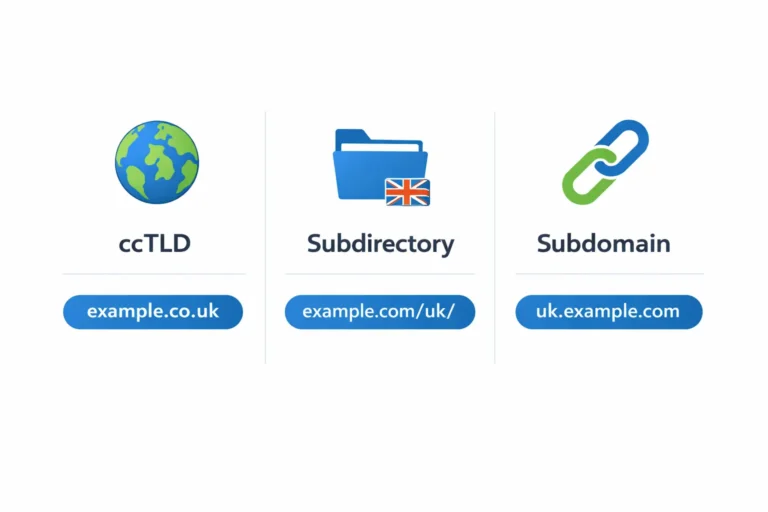
Your URL structure tells search engines which content is meant for which audience. You have three main options:
Country Code Top-Level Domains (ccTLDs) give the strongest geographic signal to search engines. For example, example.co.uk for the UK or example.de for Germany. This approach builds strong local trust but requires managing multiple domains and can be more expensive.
Subdirectories with gTLDs use a structure like example.com/uk/ or example.com/de/. This method is easier to manage, keeps all your SEO authority on one domain, and is more cost-effective. It’s the most popular choice for many businesses.
Subdomains follow a pattern like uk.example.com or de.example.com. This option sits somewhere between the other two in terms of management complexity and SEO signal strength.
2. Implement Hreflang Tags Correctly
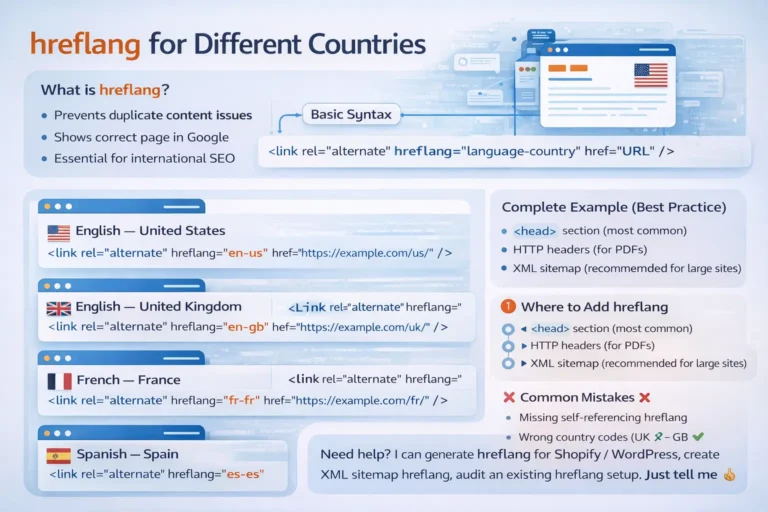
Hreflang tags are HTML attributes that tell search engines which language and regional version of a page to show users. They’re crucial for international SEO because they prevent duplicate content issues and ensure users see the right version.
Here’s how they work: when you have the same content in multiple languages, hreflang tags tell Google that these pages are related versions rather than duplicate content. They also help search engines display the correct language version in search results based on the user’s location and language settings.
Make sure every language version of a page includes hreflang tags pointing to all other versions, including itself. Also remember to use the correct language and country codes (like en-US for American English or es-MX for Mexican Spanish).
3. Localize Your Content (Don't Just Translate)
Translation converts words from one language to another. Localization adapts your entire message to resonate with a specific culture and market. This distinction makes all the difference in international SEO success.
Consider these localization factors: cultural references and idioms that make sense locally, local currencies, date formats, and measurement units, content that addresses region-specific needs and interests, and images and examples that reflect local culture and preferences.
A product description that works in New York might completely miss the mark in Tokyo, even if perfectly translated. Think about what your target audience cares about in each specific market.
4. Research Local Keywords
People in different countries search differently, even when speaking the same language. British users might search for “trainers” while Americans search for “sneakers.” Spanish speakers in Spain use different terms than those in Mexico.
Conduct keyword research specifically for each target market using local keyword tools, analyze your competitors in each region, and consider using local SEO experts or native speakers to validate your keyword choices. Don’t assume that direct translations of your main keywords will be what people actually search for.
5. Build Local Backlinks
Backlinks from websites in your target countries send strong relevance signals to search engines. They also drive qualified traffic from users in those regions.
Focus on building relationships with local bloggers, journalists, and industry websites. Participate in local online communities, sponsor local events or organizations, and create content that naturally appeals to local publishers. Quality always beats quantity when it comes to link building.
6. Consider Local Search Engines
While Google dominates most markets, some countries have different preferences. Baidu is the leading search engine in China, Yandex is popular in Russia, and Naver dominates in South Korea. If you’re targeting these markets, you’ll need to optimize for these platforms as well.
Each search engine has its own ranking factors and best practices. Research the specific requirements for any non-Google search engines that matter to your target markets.
Technical Considerations
Server Location and Site Speed
Your hosting location can affect both site speed and search rankings. Users expect fast-loading pages, and search engines factor speed into rankings. Consider using a Content Delivery Network (CDN) to serve your content from servers closest to your users, regardless of where your main server is located.
Mobile Optimization
Mobile usage varies by country, but it’s growing everywhere. Ensure your international sites are fully responsive and provide excellent mobile experiences. Test your sites on devices popular in your target markets.
Local Payment and Contact Options
Include local payment methods, phone numbers, and business addresses when possible. These elements build trust and improve conversion rates, which can indirectly benefit your SEO through better user engagement signals.
Common Mistakes to Avoid
Many businesses stumble with international SEO by using automatic redirects based on IP addresses, which prevents users from accessing other language versions and can frustrate people who speak multiple languages or are traveling. Mixing languages on the same page confuses both users and search engines. Duplicating content across different regional sites without proper hreflang implementation can also trigger duplicate content penalties.
Another frequent mistake is neglecting to translate or localize meta titles, descriptions, and alt text—these elements are just as important for SEO as your main content. Finally, ignoring local regulations like GDPR in Europe or other regional privacy laws can lead to serious legal issues.
Measuring Your International SEO Success
Track your performance separately for each target market using tools like Google Search Console’s country filters and Google Analytics with proper geographic segmentation. Monitor your rankings for local keywords, organic traffic from each region, conversion rates by country, and engagement metrics like bounce rate and time on site.
Review this data regularly to identify what’s working and where you need to adjust your strategy. International SEO is an ongoing process, not a one-time setup.
Getting Started with International SEO
If you’re just beginning your international SEO journey, start small. Choose one or two priority markets rather than trying to target every country at once. Test your approach, learn what works, and then expand to additional markets.
Invest time in understanding each market’s unique characteristics. Talk to native speakers, study local competitors, and pay attention to cultural nuances. The businesses that succeed internationally are those that genuinely connect with local audiences rather than simply pushing out translated content.